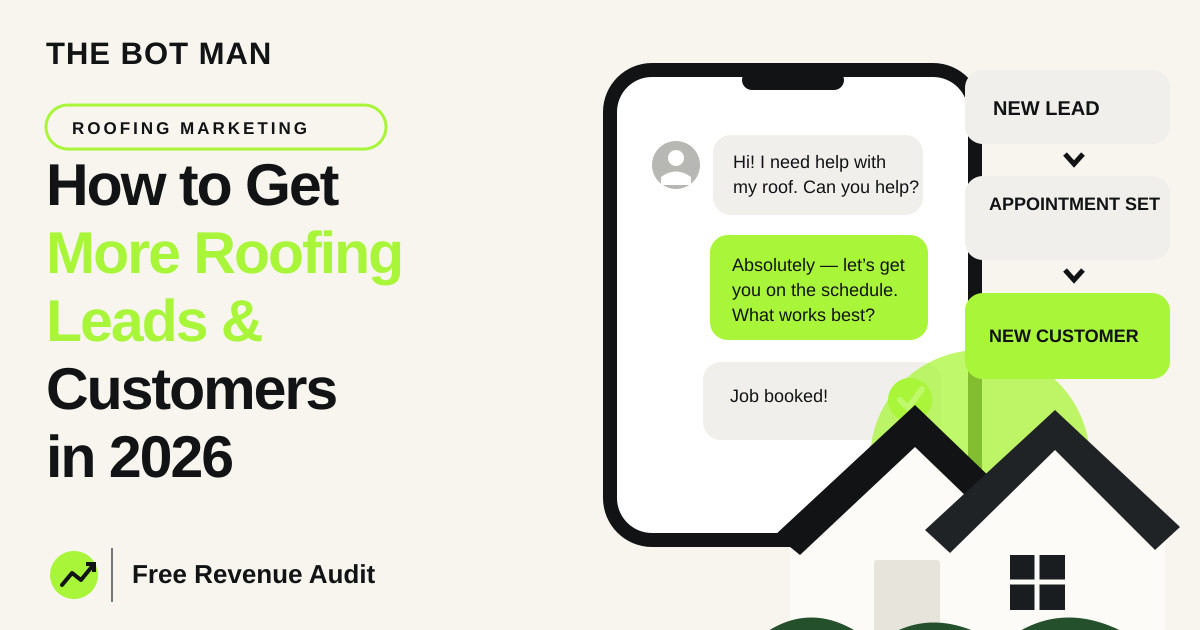
If you run a roofing company and the problem is simply “we need more jobs”, you do not need to start with complicated marketing terminology.
You need more of the right homeowners to find you, more of them to contact you, and a better system for turning those enquiries into inspections, estimates and sold jobs.
Quick answer: To get more roofing leads, focus on three things at the same time: visibility, so homeowners can find you; conversion, so more of those homeowners actually contact you; and follow-up, so fewer good opportunities disappear after the first call or form submission. For most roofers, that means some combination of Google, Local Services Ads, referrals, reviews, a strong website or landing page, fast response, estimate follow-up and reactivation of old leads.
This guide is written for roofing contractors asking basic but important questions like:
- How do I get more roofing leads?
- How do I get more roofing customers?
- How do I get more roofing jobs?
- Where should I advertise my roofing company?
- How do roofers get leads without door knocking?
- Why am I getting leads but not enough booked jobs?
The goal is not to use every marketing channel available. The goal is to build a simple system that reliably creates and converts roofing opportunities.
How do roofing companies get leads?
Roofing companies usually get leads from a mix of channels rather than one single source.
The most common categories are:
- Google Search — homeowners actively looking for a roofer.
- Google Local Services Ads — local service enquiries generated through Google’s LSA platform.
- Google Ads — paid search campaigns for high-intent roofing searches.
- Google Maps and local SEO — organic local visibility and reviews.
- Referrals — past customers, friends, neighbors, builders and other trades.
- Door knocking and canvassing — especially after storms or in targeted neighborhoods.
- Facebook and Instagram — paid or organic demand generation.
- Partnerships — realtors, insurance-related contacts, property managers and complementary contractors.
- Old lead reactivation — people who previously enquired but never bought.
- Unsold estimate follow-up — homeowners who received a quote but never made a decision.
The mistake is assuming the answer is always “get more leads.” Sometimes the company already has enough opportunities, but too many are being lost between first contact and signed job.
That is why I think about roofing growth as:
Traffic → Lead → Contacted → Qualified → Inspection → Estimate → Sold Job → Review / Referral / Reactivation
If one stage is weak, buying more traffic can simply send more leads into the same leak.
1. Get more roofing leads from Google Search
When a homeowner searches something like:
- roof replacement near me;
- roofing contractor near me;
- roof repair company;
- storm damage roofer;
- metal roofing contractor;
- emergency roof repair;
…they are showing much stronger intent than someone casually scrolling social media.
There are three main ways to appear in that moment:
Organic search
This is your website appearing naturally in Google results.
To improve it, your site should clearly explain:
- what roofing services you provide;
- which cities or service areas you cover;
- why someone should trust your company;
- what happens when they request an inspection or estimate;
- how to contact you quickly;
- what real customers say about the business.
You also need useful pages that answer the questions roofing prospects and roofing business owners are actually searching.
Google Maps
Your Google Business Profile can be one of the highest-intent sources of local roofing calls.
Keep the profile accurate, collect genuine reviews, upload current project photos, maintain service information and make it easy for homeowners to call or visit your website.
Paid Google Search
If you want visibility faster, Google Ads for roofers can put the company in front of people already searching for roofing services.
The important part is not just buying clicks. You need to know which calls and forms become real roofing opportunities.
If you are trying to work out a sensible spend, use the Roofing Marketing Budget Calculator and our guide on how much roofers should spend on Google Ads.
2. Use Google Local Services Ads where they make sense
Local Services Ads can be another way to capture homeowners who are actively looking for local roofing help.
The right question is not whether LSAs are universally better than standard Search Ads. The right question is:
Which channel creates more qualified roofing opportunities at an acceptable cost for your company?
Track:
- valid leads;
- booked inspections;
- estimates;
- sold jobs;
- customer acquisition cost.
Our comparison of Google Ads vs Local Services Ads for roofers goes deeper into how to judge the two channels.
3. Make your roofing website convert more visitors into leads
More traffic does not automatically mean more customers.
If 500 homeowners visit a weak website, you can still end the month with very few real enquiries.
A roofing website should answer the homeowner’s basic questions quickly:
- Do you work in my area?
- Do you do the type of roof I need?
- Can I trust you?
- What should I do next?
- Can I call now?
- Can I request an inspection or quote?
A good roofing landing page should have:
- one obvious primary action;
- visible phone number;
- short enquiry form;
- clear service-area information;
- reviews or trust signals;
- real project imagery where possible;
- service-specific copy;
- fast mobile loading;
- no unnecessary distractions before the enquiry.
If you are paying for ads, sending every visitor to a generic homepage can make it harder to match the page to what they searched for.
4. Respond to new roofing leads faster
Getting the lead is only the first half of the job.
Roofing teams are busy. Calls come in while someone is driving, on a roof, speaking with another homeowner or away from the office.
That is exactly why response systems matter.
At minimum, every new enquiry should have:
- immediate acknowledgement;
- clear ownership;
- a callback or response task;
- repeated follow-up when appropriate;
- a defined next step such as inspection booking.
Our guide on how fast roofers should follow up with leads explains how to structure that first-response window.
And if unanswered phone calls are common, see how much missed roofing calls may be costing you.
5. Recover missed roofing calls
A missed call should not automatically become a lost customer.
A simple missed-call recovery process can:
- acknowledge the caller immediately;
- tell them the team is unavailable right now;
- invite them to reply by text;
- create a callback task;
- assign the enquiry to someone;
- keep it visible until it is resolved.
That does not replace a human salesperson. It simply stops good enquiries from disappearing because nobody answered at the exact second the homeowner called.
This belongs inside a proper roofing CRM so unanswered calls, website leads and inspection requests do not live in separate places.
6. Follow up with leads who do not answer the first time
One of the easiest ways to waste paid roofing leads is to try once and give up.
A homeowner may be:
- at work;
- speaking to another roofer;
- driving;
- dealing with an insurance issue;
- waiting for a spouse or other decision-maker;
- simply not ready to talk at that exact moment.
Use a short, professional follow-up sequence across calls, text and email rather than repeatedly sending the same message.
Our roofing follow-up scripts include practical examples for new leads, missed calls, inspections, estimates and reactivation.
7. Get more roofing jobs from the estimates you already sent
Many roofing companies focus heavily on generating estimates and not enough on what happens after the estimate is delivered.
An unsold estimate is not necessarily a dead opportunity.
Build a follow-up process that includes:
- confirmation that the homeowner received the proposal;
- a scheduled salesperson task;
- useful answers to common objections;
- a clear way to ask questions;
- a reasonable follow-up cadence;
- a longer-term nurture path when the timing is not right.
If you want more jobs without increasing ad spend first, this can be one of the best places to look.
See how to increase roofing estimate close rate for a deeper process.
8. Reactivate old roofing leads and estimates
Before spending another dollar to acquire strangers, look at the people already sitting in your database.
Useful segments can include:
- old leads who never booked;
- inspections that never became estimates;
- unsold estimates;
- past customers;
- homeowners who said “not now”;
- older storm-related enquiries;
- customers who may now need another service.
A reactivation campaign should not blast the entire database with the same generic message.
Segment the list, make the reason for contacting them relevant, and make it easy to restart the conversation.
Our guide on reactivating old roofing estimates gives a practical framework.
9. Ask happy customers for reviews and referrals
A completed roofing job can create more than one customer.
A simple post-job process can include:
- asking for a Google review;
- requesting permission to use project photos;
- sending a referral reminder;
- checking in later;
- keeping the customer in a past-customer segment rather than forgetting them forever.
For local roofing companies, strong reviews also reinforce the Google Maps and trust side of the lead-generation system.
10. Use Facebook and Instagram to create demand
Not every roofing lead starts with a Google search.
Meta advertising can help create demand around:
- storm damage;
- roof age;
- seasonal inspections;
- financing offers;
- specific neighborhoods;
- educational roofing content;
- before-and-after work;
- homeowner problems they may not yet be actively searching for.
The trade-off is intent.
A person searching “roof replacement near me” is already looking for help. Someone seeing a Facebook ad may only be starting to think about the problem.
That means Meta leads often need stronger qualification and follow-up rather than being judged only by a cheap front-end cost per lead.
How to get roofing leads without door knocking
Door knocking can work, especially in storm-affected neighborhoods, but it does not have to be your only growth strategy.
A roofing company can generate leads without door knocking through:
- Google Search Ads;
- Google Local Services Ads;
- Google Maps;
- SEO;
- referrals;
- Facebook and Instagram;
- partnerships;
- email and SMS reactivation;
- review-driven local visibility;
- direct mail in targeted areas;
- strong follow-up on existing estimates.
The right mix depends on your market, budget, sales capacity and service type.
For many companies, the most reliable long-term setup is more than one lead source feeding one consistent sales process.
How to get roofing leads for free
Truly free lead generation is difficult because even “free” channels require time, labor, reputation or existing relationships.
But the lowest-cash-cost opportunities usually include:
- asking past customers for referrals;
- collecting more Google reviews;
- posting completed projects;
- improving your Google Business Profile;
- following up with unsold estimates;
- reactivating old leads;
- contacting past customers;
- building referral relationships with complementary businesses.
If cash is tight, I would usually start with the database and reputation you already own before chasing a brand-new platform.
How much should you pay for roofing leads?
Do not judge a lead only by the price attached to it.
The useful question is:
How much did it cost to acquire a profitable roofing job?
Track the stages between spend and revenue:
Spend → Leads → Qualified Leads → Booked Inspections → Estimates → Sold Jobs
A $200 lead can be excellent if it becomes a profitable roof replacement.
A $50 lead can be expensive if nobody answers, it is outside your service area or it never becomes an inspection.
Our guide to roofing lead cost explains how to calculate cost per qualified lead, cost per booked inspection and customer acquisition cost instead of relying only on raw CPL.
The simple roofing growth system I would build first
If a roofing company asked me, “Where do I start if I just want more customers?” I would build in this order:
Step 1: Make sure every lead source is tracked
Know where calls and forms came from.
Step 2: Fix the response process
No new lead should sit untouched because nobody knew who owned it.
Step 3: Create a usable pipeline
A simple pipeline might include:
New Lead → Contacted → Qualified → Inspection Booked → Estimate Sent → Won / Lost / Nurture
Step 4: Recover missed opportunities
Add missed-call recovery, lead follow-up and estimate follow-up.
Step 5: Reactivate the database
Work old leads and unsold estimates before assuming you need more traffic.
Step 6: Scale the lead sources that actually create jobs
Once tracking is trustworthy, invest more into the channels producing qualified opportunities and profitable customers.
That is essentially the philosophy behind our broader roofing marketing agency service: lead generation and the post-lead sales process should be managed as one connected system.
A 30-day plan to get more roofing customers
If you want something practical to work through over the next month:
Week 1 — Fix the basics
- Check every website form.
- Test every tracking number.
- Review your Google Business Profile.
- Make sure leads have a clear owner.
- Build a simple pipeline.
- Measure current response time.
Week 2 — Recover existing demand
- Follow up with open estimates.
- Reactivate older leads.
- Contact past customers where appropriate.
- Ask satisfied customers for reviews.
- Create a missed-call process.
Week 3 — Improve acquisition
- Review current Google Ads or LSAs.
- Remove obvious wasted targeting.
- Improve landing-page clarity.
- Make service areas and roofing services obvious.
- Start one channel you can measure properly rather than five you cannot.
Week 4 — Measure what became real opportunities
For every source, calculate:
- leads;
- contacted leads;
- qualified leads;
- inspections booked;
- estimates;
- closed jobs;
- acquisition cost.
Then decide where the next dollar and the next hour should go.
The most important roofing lead-generation mistake to avoid
Do not separate marketing from follow-up.
If one company manages ads, another person answers calls, estimates live somewhere else and old leads sit untouched, it becomes very difficult to know why growth is inconsistent.
The strongest system connects:
lead source + website + calls + CRM + response time + inspection booking + estimate follow-up + closed-job reporting
That is how you move from “we need more leads” to knowing where more jobs are actually going to come from.
FAQ
How can I get more roofing leads?
Increase local visibility through channels such as Google Search, Google Maps, Local Services Ads, referrals and paid advertising, then improve the website, response process and follow-up so a higher percentage of those opportunities become inspections and estimates.
How can I get more customers for my roofing company?
Do not focus only on brand-new leads. Improve lead response, follow up with unsold estimates, reactivate old leads, ask past customers for referrals and reviews, and scale the acquisition channels that are creating profitable jobs.
What is the best way to get roofing leads?
There is no single best channel for every roofer. High-intent Google traffic is attractive because the homeowner is actively searching, while referrals can be extremely valuable because trust is already present. The best mix is the one that consistently creates qualified opportunities at an acceptable acquisition cost for your company.
How do roofers get leads without door knocking?
Google Ads, Local Services Ads, Google Maps, SEO, referrals, partnerships, social advertising, old-lead reactivation and estimate follow-up can all generate opportunities without relying on door-to-door canvassing.
How can I get roofing leads for free?
Start with assets you already have: past customers, old leads, unsold estimates, Google reviews, referrals, project photos and your Google Business Profile. These still require time and effort, but they can create opportunities without purchasing each new lead.
Why am I getting roofing leads but not enough jobs?
The leak may be after the lead arrives. Check response time, contact rate, qualification, inspection booking, estimate delivery, estimate follow-up and close rate. If you only measure raw lead volume, you may miss the stage where opportunities are actually being lost.
Should a roofing company use a CRM?
If you are handling enough leads that enquiries, inspections, estimates and follow-up tasks are difficult to manage reliably, a CRM becomes increasingly useful. See our guide to the best CRM considerations for roofing companies and our roofing CRM management service page.
How much should a roofing company spend on marketing?
It depends on growth targets, gross profit, close rate, sales capacity and the cost of qualified opportunities in your market. Our guide to roofing marketing costs and the roofing marketing budget calculator can help you work backward from jobs rather than guessing a percentage.