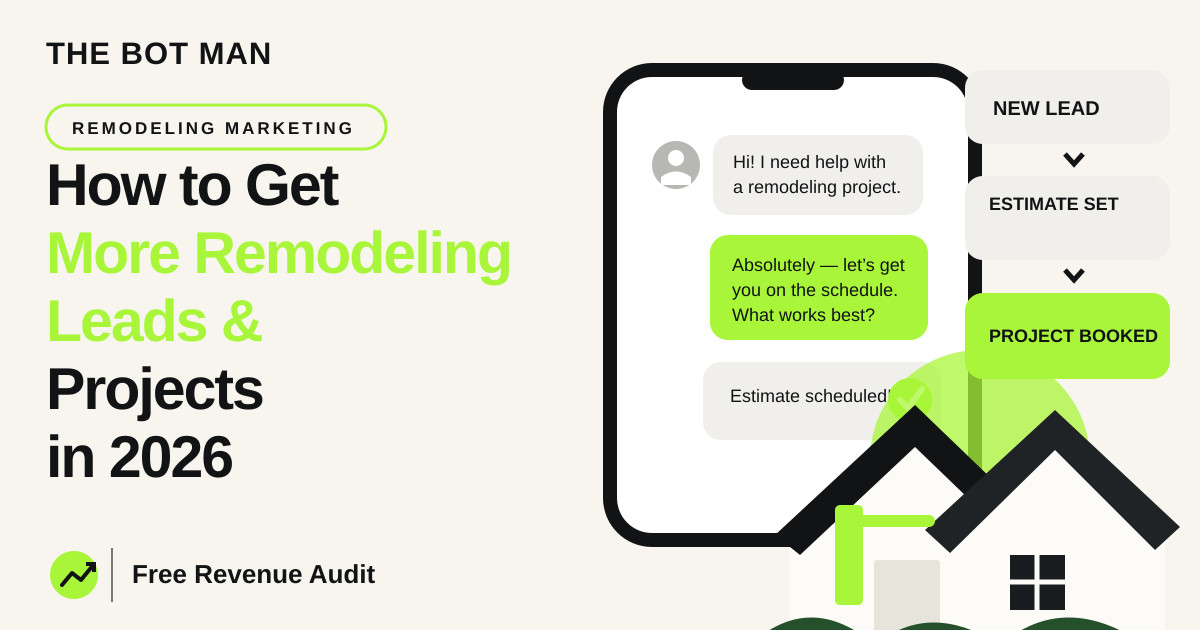
If you run a remodeling company or general contracting business, you probably do not wake up thinking, “I need a better acquisition funnel.”
You think something much simpler:
“I need more good projects.”
That is the right place to start.
Quick answer: To get more remodeling leads, you need more qualified homeowners to find your company, a clear reason for them to contact you, and a reliable process for turning enquiries into consultations, proposals and signed projects. For most remodelers, that means combining Google visibility, paid search, referrals, strong project pages, fast response, estimate follow-up and reactivation of older opportunities.
The mistake is treating lead generation as a separate problem from sales follow-up. A remodeler can generate more enquiries and still stay stuck if calls are missed, consultations are slow to book, proposals sit untouched or older prospects are forgotten.
This guide covers both sides.
How do remodeling companies get leads?
Most remodeling companies get work from some combination of:
- referrals and past customers;
- Google Search;
- Google Maps / local search;
- paid Google Ads;
- Local Services Ads where available;
- social media and project showcases;
- home-service directories;
- builders, designers, real-estate professionals and other referral partners;
- yard signs and local reputation;
- old leads and unsold estimates;
- repeat work from previous clients.
The strongest businesses usually do not depend on only one source.
A remodeler who gets almost everything through referrals can have an excellent reputation but still experience unpredictable months. A company that relies only on paid leads can become vulnerable to rising acquisition costs. The goal is a repeatable mix of demand sources plus a sales process that converts the demand you already have.
1. Make Google understand exactly what remodeling work you want
One of the simplest ways to get more remodeling clients is to stop presenting your company as if every project is the same.
A homeowner planning a kitchen remodel is not searching the same way as someone planning:
- a bathroom remodel;
- a basement renovation;
- a room addition;
- a whole-home remodel;
- an accessory dwelling unit;
- an exterior renovation;
- a commercial tenant improvement.
Your website should make the services, locations and project types you actually want obvious.
That usually means dedicated pages for your strongest services rather than one generic page saying you “do renovations.”
A useful service page should answer:
- What type of project do you handle?
- What areas do you serve?
- What does your process look like?
- What type of homeowner or project is a good fit?
- What proof can you show?
- What should the visitor do next?
This helps both search engines and homeowners understand whether you are relevant.
2. Use Google Search Ads for high-intent project searches
If someone searches for a kitchen remodeling contractor, bathroom remodeler, home addition contractor or general contractor near me, there is usually meaningful commercial intent behind the search.
That is why paid search can work well for remodeling companies.
But the campaign should not simply buy every keyword containing the word “contractor.”
Good remodeling campaigns usually need control over:
- service area;
- project type;
- negative keywords;
- call and form tracking;
- brand vs non-brand traffic;
- landing-page relevance;
- lead qualification;
- downstream outcomes such as consultations and signed projects.
The important metric is not just cost per form submission.
A better chain is:
Ad spend → Lead → Qualified lead → Consultation booked → Proposal → Signed project → Revenue
That is the same principle behind our broader guide to Google Ads for contractors.
3. Improve your Google Business Profile and local visibility
A homeowner comparing remodelers will often search your company name, read reviews and look through photos before contacting you.
That makes your local presence part of lead generation even when the original discovery happened somewhere else.
Keep your business information accurate and make sure your profile reflects the type of work you want more of.
Useful signals include:
- recent project photos;
- detailed reviews;
- accurate service areas;
- current phone and website information;
- consistent business details across the web;
- project descriptions that naturally mention the services you completed.
Do not fake locations or create spam listings. Local authority grows much better from a real operating footprint and genuine project history.
4. Turn project photos into sales assets, not just social posts
Remodelers have an advantage many service businesses do not: the work is visual.
A strong before-and-after can do more than earn likes.
Turn completed projects into pages or case studies that explain:
- what the homeowner wanted;
- what the space looked like before;
- the scope of the project;
- important design or construction decisions;
- the finished result;
- the city or service area where appropriate;
- the type of project the company wants more of.
That gives prospects proof while also creating useful search content.
A kitchen remodeling company with 20 strong local project pages is building a much more useful organic asset than a company whose entire portfolio lives only inside Instagram.
5. Make it ridiculously easy for homeowners to enquire
Some remodeler websites make a motivated homeowner work too hard.
Common friction includes:
- no visible phone number;
- vague calls to action;
- huge forms asking for too much information;
- slow mobile pages;
- forms that do not clearly confirm submission;
- no way to schedule a conversation;
- unclear service areas;
- no indication of project fit.
The first conversion does not need to sell a $50,000 project.
It only needs to create the next useful step.
For many remodeling companies, that could be:
Request a consultation
or
Tell us about your project
Then the sales process can qualify budget, scope, timeline and fit.
6. Respond faster than the other remodelers
High-ticket projects often have long sales cycles, but the first response should still be fast.
A homeowner may contact several contractors in the same afternoon. If one company responds quickly, asks useful questions and gives a clear next step while another replies two days later, the slower company is already behind.
The first response does not need to be pushy.
It can simply confirm the enquiry, set expectations and move the homeowner toward a conversation.
For example:
New enquiry → immediate acknowledgement → personal call/text → qualification → consultation booked
If nobody can answer every call, missed-call text-back can help recover enquiries that would otherwise disappear.
7. Qualify remodeling leads before wasting estimating time
Not every lead deserves hours of design, estimating and site-visit time.
A remodeling company should define what a qualified opportunity actually means.
Depending on the business, qualification may include:
- correct service area;
- project type you actually perform;
- homeowner / decision-maker involvement;
- realistic timeline;
- project size;
- budget range where appropriate;
- financing or payment expectations;
- property type;
- whether the project requires design work first.
This is particularly important for general contractors because a generic “construction lead” can mean almost anything.
A good system gets the right information early without making the homeowner feel interrogated.
8. Follow up after the consultation and proposal
This is one of the biggest opportunities in remodeling.
The homeowner has contacted you. Someone may have driven to the property. Measurements were taken. A scope was discussed. A proposal was prepared.
Then the estimate gets sent and… silence.
That is an expensive point to lose the opportunity.
Proposal follow-up should not depend entirely on someone remembering to call.
A practical process might include:
- confirmation that the proposal was received;
- a scheduled salesperson task;
- a useful check-in a few days later;
- answers to common objections or questions;
- a second personal call;
- longer-term nurture when the timing changes.
See our contractor estimate follow-up sequence for a practical structure.
9. Keep longer remodeling sales cycles organized
A bathroom repair may move quickly. A six-figure renovation may not.
Homeowners can spend weeks or months thinking about:
- financing;
- design;
- scope;
- material selections;
- permits;
- whether to move forward at all;
- which contractor they trust most.
That makes pipeline management especially important for remodelers.
Your CRM should make it obvious whether an opportunity is:
New Lead → Contacting → Qualified → Consultation Booked → Site Visit Complete → Proposal / Design Phase → Decision Pending → Won / Lost / Long-Term Nurture
The exact stages can vary, but every open opportunity should have an owner and a next action.
Our guide to CRM pipeline management for contractors and remodelers goes deeper into this structure.
10. Reactivate old remodeling leads and unsold estimates
If your company has been operating for a while, there may already be revenue sitting in the database.
Look for:
- enquiries that never booked a consultation;
- consultations that never received a proposal;
- proposals that went cold;
- homeowners who postponed work;
- projects delayed because of financing;
- past customers who may need another phase of work;
- old prospects who originally said “not now.”
These people already know your company.
A well-segmented reactivation campaign can be cheaper than buying another batch of completely cold traffic because the relationship has already started.
The key is not blasting every old contact with the same message. Segment by stage, project type, age of opportunity and original reason the project did not move forward.
See lead reactivation for contractors for the broader framework.
11. Build a real referral system
Referrals are powerful in remodeling because trust matters so much.
But “we get referrals” is not the same as having a referral system.
After a successful project, create a repeatable process for:
- asking for a review;
- checking in after completion;
- reminding past clients about additional services;
- making it easy to introduce a friend or neighbor;
- keeping relationships with designers, real-estate professionals, architects and complementary trades alive.
The best referral strategy is usually not an aggressive discount program. It is staying memorable after delivering good work.
12. Use social media to support trust, not replace lead generation
Instagram, Facebook, YouTube and short-form video can help homeowners become familiar with your work.
Good remodeling content includes:
- before-and-after transformations;
- walkthroughs;
- project progress;
- material comparisons;
- common renovation mistakes;
- budget education;
- “what to expect” videos;
- answers to homeowner questions;
- introductions to the team.
But social reach alone is not a reliable sales system.
The content should lead somewhere: your site, a consultation form, a booking page or another clear next step.
How can a general contractor get more jobs?
General contractors face the same core problem, but the lead pool can be broader.
A GC may want:
- full home renovations;
- additions;
- commercial build-outs;
- insurance restoration;
- new construction;
- specialty project management;
- larger subcontracted scopes.
The first step is deciding which jobs you actually want more of.
“General contractor” is too broad to be a marketing strategy by itself.
Build campaigns and pages around profitable project categories, then measure which sources create real opportunities rather than generic enquiries.
What numbers should a remodeling company track?
Do not stop at total leads.
Track:
| Funnel stage | What to measure |
|---|---|
| Lead | Calls and forms generated |
| Contacted | Leads your team actually reached |
| Qualified | Opportunities matching your project criteria |
| Consultation | Qualified leads that booked |
| Proposal | Opportunities that received pricing/scope |
| Won | Signed projects |
| Revenue | Contract value attributed to source |
From there, calculate:
- cost per lead;
- cost per qualified lead;
- cost per consultation;
- proposal close rate;
- customer acquisition cost;
- revenue by lead source.
That is much more useful than asking whether Facebook gave you cheaper leads than Google without knowing whether either source produced signed projects.
Why remodeling leads often fail to turn into projects
When a remodeling company says, “we need better leads,” sometimes the lead source really is the problem.
But sometimes the leak is later.
Common examples include:
- response takes too long;
- nobody consistently owns new enquiries;
- the company does not qualify early;
- consultations are difficult to schedule;
- the homeowner never receives useful follow-up;
- proposals are sent without a next step;
- long-term prospects disappear from view;
- nobody tracks why deals are lost;
- old opportunities are never revisited.
That is why our contractor marketing agency approach connects lead generation with CRM, follow-up and reactivation rather than treating them as unrelated services.
A simple 30-day plan to get more remodeling projects
If your current process is inconsistent, do not try to rebuild everything at once.
Week 1: Fix the foundation
- define your ideal project types;
- define your service area;
- review website calls to action;
- test every form and phone number;
- make sure leads have a clear owner;
- define what counts as a qualified lead.
Week 2: Improve visibility
- improve your strongest service pages;
- update project photos and case studies;
- strengthen Google Business Profile content;
- collect missing reviews from completed projects;
- identify your highest-intent Google searches.
Week 3: Fix follow-up
- create immediate lead acknowledgement;
- create a first-contact task;
- add consultation reminders;
- build a proposal follow-up sequence;
- create a long-term nurture stage.
Week 4: Create more demand
- launch or tighten paid search;
- contact referral partners;
- reactivate older opportunities;
- publish one useful project-focused article or case study;
- review which lead sources created consultations, not just enquiries.
Then repeat based on the numbers.
FAQ
How do I get more remodeling leads?
Increase the number of qualified homeowners who can find you through Google, local search, referrals, paid advertising and project content, then improve the process that turns those enquiries into consultations and proposals. More traffic alone will not solve weak lead handling.
What is the best way to get remodeling clients?
There is no single best source for every market. Referrals, Google Search, Maps/local SEO, paid search and past-client reactivation can all work. The best channel is the one that produces qualified projects at an acquisition cost your margins can support.
How do I get more general contractor jobs?
Choose the project categories you want, create service and location pages around them, build visibility in Google, use paid search where the economics make sense, develop referral relationships and track every enquiry through consultation, proposal and close.
How can a remodeling company get leads without buying leads?
Organic Google visibility, Google Business Profile optimization, referrals, past-customer outreach, project case studies, local partnerships and old-lead reactivation can all create enquiries without paying a lead vendor for each contact. They still require time or marketing investment.
Should remodelers buy leads from Angi, Thumbtack or other lead marketplaces?
They can be one channel, but judge them by qualified consultations and signed projects rather than raw lead count. Understand whether leads are shared, how quickly they are distributed, what replacement/refund rules exist and whether the project types match your business.
Why am I getting remodeling leads but not closing projects?
Check the full funnel before blaming lead quality. Look at response time, qualification, consultation show rate, proposal delivery, follow-up, pricing, trust, sales process and lost reasons. If qualified homeowners are reaching proposal stage and then disappearing, the problem may be after lead generation.
How fast should a remodeler respond to a new lead?
As quickly as your team can respond consistently and professionally. The goal is to acknowledge the enquiry while intent is fresh, then move the homeowner toward qualification and a consultation rather than leaving them unsure whether anyone received the request.
What should a remodeling CRM track?
At minimum: lead source, project type, service area, qualification status, consultation date, proposal stage, assigned owner, next action, estimated project value and lost reason. For a practical setup, see CRM for contractors.